
Books by Madam Lether
This page offers an in-depth look at Madam Lether’s published books, approached one title at a time. Each section focuses on a single book as a complete work, its themes, ideas, inspirations, and the questions it engages with rather than presenting the stories as isolated pieces or sales items.
While individual stories and characters are discussed where relevant, the emphasis here is on the books themselves: what each work is about, where its ideas originated, and how it fits within the wider body of writing. Some books grow out of shared concerns or recurring imagery; others stand apart in form or tone. This page is intended to give readers a deeper understanding of how each book was shaped, and what it is trying to do.
Whether you are new to the work or returning with familiarity, this page is designed as a guide to the books as authored objects exploring their internal logic, creative influences, and thematic foundations.
Bonnie in the Machine
Plot Overview
One cold night, Bonnie crawls into the only place left that’s warm. She builds a home from scraps and rhythm, learning the strange order hidden in the walls.
Outside, the city turns cruel: traps, poison, and the quiet erasure of everything small. Inside, alliances form, danger waits in the shadows, and survival becomes its own belief system. The book is described as an animal fantasy epic. Watership Down reimagined beneath the concrete and wires of the modern city and as a story about endurance, community, and the defiant grace of the overlooked.
Bonnie in the Machine was published by The Library of Shadows and is listed with ISBN 9781919251370 (1919251375). Multiple retailers list its publication date as 9 January 2026. Early reception has been warm, with initial reader feedback rating it highly on major listings (including a 5-star customer review on one of the main book retail pages).

The Story Behind Bonnie in the Machine
The initial inspiration for Bonnie in the Machine came from a real incident following a house move. After noticing a persistent smell coming from her car, Madam Lether discovered that rats had taken up residence inside the vehicle. A visit from Rentokil confirmed the situation the technician physically recoiled on seeing movement inside the car itself. Footage of this moment still exists, capturing the shock and sudden realisation that the car had become a temporary shelter for wildlife.
Rather than approaching the situation purely as a problem to be solved, the experience sparked a creative shift in perspective. A conversation with Lentil Pulse led to the name Bonnie, inspired by the idea of a rat living beneath the bonnet of the car. From there, the concept expanded: what if the story were told not from the human point of view, but from the animal’s a creature simply seeking warmth, safety, and continuity in a world shaped by human systems it cannot understand?
While Bonnie in the Machine is fictional, its foundation lies in this real encounter. The book does not retell the event directly, but reimagines it through the perspective of the rat, allowing the narrative to explore survival, displacement, and urban environments from below. What began as a brief, unsettling discovery became the seed for a much larger story one rooted in observation, reframed through empathy, and transformed into fiction.

Cover Details and Development
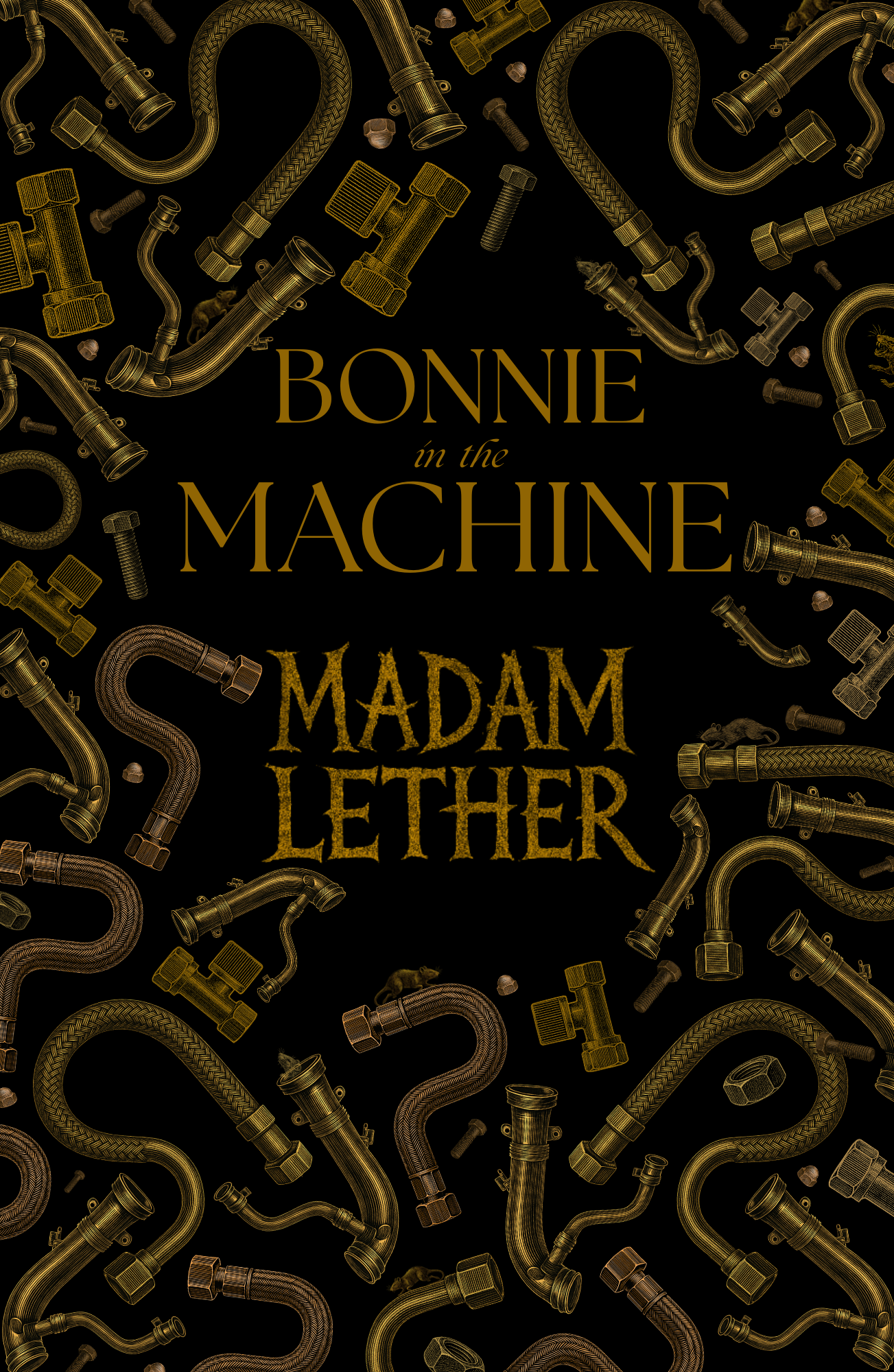
The final cover of Bonnie in the Machine is deliberately dense with hidden detail. At first glance, the design appears abstract: a repeating field of pipes, hoses, bolts, and mechanical fittings rendered in gold against black. On closer inspection, however, small rats are woven throughout the composition. Some are immediately visible; others are partially obscured by machinery, tucked between curves of pipework or nestled among bolts and joints.
These rats are not placed as a single focal point but dispersed across the cover, mirroring Bonnie’s existence within the book itself present, watchful, and embedded within a hostile mechanical environment. The imagery reflects the central tension of the story: a living creature surviving inside systems that were never built to accommodate it. The cover rewards careful looking, encouraging the reader to slow down and notice what is usually overlooked.
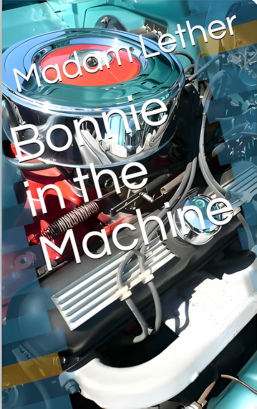
Alongside the final cover, an earlier concept was developed using a photographic image of a car engine bay. This original design drew more directly from the real-life incident that inspired the book, grounding the story visually in its point of origin. While effective as a literal reference, the image was ultimately set aside in favour of the illustrated final version. The completed cover was chosen for its ability to translate the book’s themes more broadly moving from a specific moment to a symbolic environment that better represents the story’s scope, tone, and perspective.
Together, the two covers document the evolution of Bonnie in the Machine from lived experience to finished fiction, showing how the project shifted from direct representation toward a more layered, interpretive visual language.

The Audio Series
Bonnie in the Machine was later adapted into an official episodic audio series, expanding the story beyond the page and into sound. The series was written and narrated by the author, preserving the voice, rhythm, and perspective of the original text, and allowing the story to be experienced as a continuous interior narration rather than a dramatised adaptation.
The audio series came together through a close, independent production process, developed outside of traditional publishing and broadcast structures. Produced by ChapterCast, the series was designed to remain intimate and direct, prioritising atmosphere, pacing, and clarity over embellishment. Rather than adding external voices or sound-heavy reinterpretations, the adaptation focused on letting the language and perspective of the book carry the experience.
Released episodically and made available to stream for free on Spotify and other major platforms, the series offered a low-barrier entry point for new audiences, while also providing existing readers with a different way to engage with the text. Listener responses have highlighted the effectiveness of author narration in maintaining the story’s tone and emotional continuity, with particular attention paid to how the audio format reinforces Bonnie’s close, ground-level perspective.
Together, the book and the audio series form two expressions of the same work: one read privately on the page, the other heard over time. The adaptation reflects the wider ethos behind Bonnie in the Machine small-scale, independent, and shaped deliberately by the people closest to the work itself.
Where to Find Bonnie in the Machine
Bonnie in the Machine is available in multiple formats and through several major retailers:
Paperback and print editions can be ordered online through booksellers such as Amazon UK and Blackwell’s Bookshop, in addition to other national and independent retailers.
E-book editions are also listed on platforms including Amazon for electronic readers and apps.
Bibliographic listings for the book are available on Google Books, confirming publication details.
The official audio series adaptation of Bonnie in the Machine written and read by Madam Lether is available to stream on major audio platforms. Early episodes have been shared on services such as Spotify, and patrons of the author’s creator platform receive early access to new episodes before they appear elsewhere.
Publication and Availability Details
Publication Date: 9 January 2026 (print and digital)
Publisher: The Library of Shadows
ISBN: 978-1-919251-37-0
Across both print and audio formats, Bonnie in the Machine continues to reach readers and listeners through familiar retail and streaming channels, making it accessible in both physical and digital forms as well as through audio platforms for audiences who prefer spoken narration.

Tales from the Algorithm
Overview
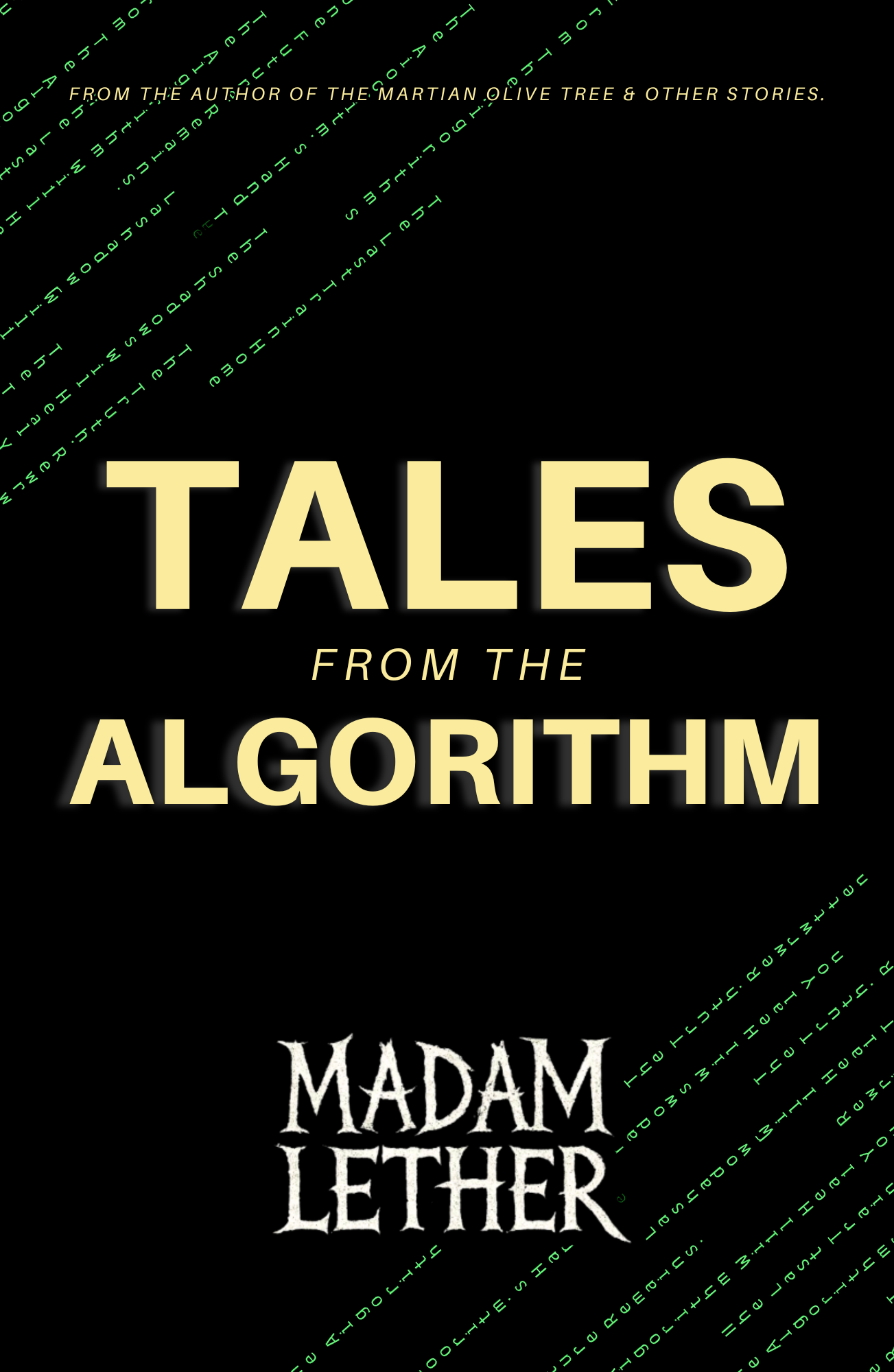
Tales from the Algorithm is a short story collection exploring horror, unease, and identity within digital and technological spaces. The book brings together a range of standalone stories that examine how modern systems platforms, algorithms, online environments, and mediated identities shape human behaviour, memory, and perception.
Rather than focusing on a single setting or recurring cast, the collection moves across different scenarios and narrative approaches. Each story engages with a specific technological pressure point, from online visibility and data permanence to surveillance, digital personas, and the erosion of privacy. While the stories are independent, they are linked by a shared concern with how technology reframes power, control, and agency.
As a collection, Tales from the Algorithm presents technology not as neutral background, but as an active force that influences relationships, selfhood, and fear. The book situates its horror firmly in the contemporary moment, drawing attention to systems that are familiar, widely used, and often invisible until something goes wrong.

Twenty-Five Years in the Making
Tales from the Algorithm represents a body of ideas that developed slowly over more than two decades. The earliest concepts behind the collection began roughly twenty-five years ago, long before the stories themselves were written, as fragments of unease shaped by technology, intimacy, and fear. Early influences came from horror that recognised fear rather than dismissing it stories that acknowledged otherness, transformation, and the tension between being seen and being hunted.
One of the collection’s foundational ideas originated with Alexander, a story concept conceived decades earlier and revisited over time. The question at its core was how predation might manifest in a modern world not through castles or dark alleys, but through screens, lenses, and emerging technologies. Webcams, online spaces, and mediated relationships became a new point of entry for horror, reframing old fears through contemporary systems. Though the idea lay dormant for years, it seeded a broader line of questioning that would eventually define the collection.
For much of that time, these stories existed without form. Ideas accumulated but remained unwritten, held back by fear, lack of confidence, and the pressure of imagined judgment. The shift came with a change in permission: choosing to write without waiting to be chosen, allowing drafts to be messy, and trusting that voice emerges through use rather than hesitation. When the writing finally began in earnest, it came as a release a flood of stories shaped by years of observation, fear, and reflection.
Tales from the Algorithm ultimately took shape around a set of recurring concerns: surveillance, intimacy, optimisation, and transformation. The collection gathers what might be described as warnings small red flags embedded within stories that examine how engineered systems can distort connection, consent, and identity. Written at a time when everyday life is increasingly mediated by unseen algorithms, the book belongs to a moment where curation decides what rises, what vanishes, and what is allowed to linger.
The Documentary
The long gestation of Tales from the Algorithm led directly to the creation of a feature-length documentary, Tales from the Algorithm: 25 Years in the Making, produced by ChapterCast Originals in association with The Library of Shadows.
The film documents the creative journey behind the collection, drawing together exclusive interviews, archival material, and behind-the-scenes footage. Rather than focusing solely on the finished book, the documentary examines the process itself how ideas evolve, stall, return, and eventually cohere into a body of work. It captures the tension between creation and control, reality and illusion, and the persistent influence of technology on storytelling.
Together, the book and the documentary form two parts of the same project: one a collection of stories shaped over decades, the other a record of the path that brought them into being.

Release & Launch
The release of Tales from the Algorithm marked a significant moment in Madam Lether’s career, representing her first full-length published collection. The book launched with a live digital event, attended by approximately 250 people, bringing together readers, collaborators, and supporters from across multiple platforms.
The digital launch coincided with several major releases and premieres. As part of the event, The Last Train Home was made available as a free downloadable short story, offering an immediate entry point into the collection’s themes. The evening also featured the worldwide premiere of the feature-length documentary Tales from the Algorithm: 25 Years in the Making, which documents the long creative journey behind the book and its ideas.
Alongside the documentary, the launch included the first public showing of WHICH; Madam Lether’s first officially released animated story. marking an expansion of the work into visual storytelling. The event also introduced Behind the Code, a companion series offering in-depth discussion of each story in the collection. Episodes of Behind the Code were released across Madam Lether’s social media channels in the months following publication, extending the conversation around the book beyond its initial release.
In addition to the digital launch, an in-person launch event was held at Reading Biscuit Factory, attended by over 45 people. The evening featured live readings and discussion from Tales from the Algorithm, offering audiences the opportunity to engage directly with the work in a shared physical space.
Your content goes here. Edit or remove this text inline or in the module Content settings. You can also style every aspect of this content in the module Design settings and even apply custom CSS to this text in the module Advanced settings.

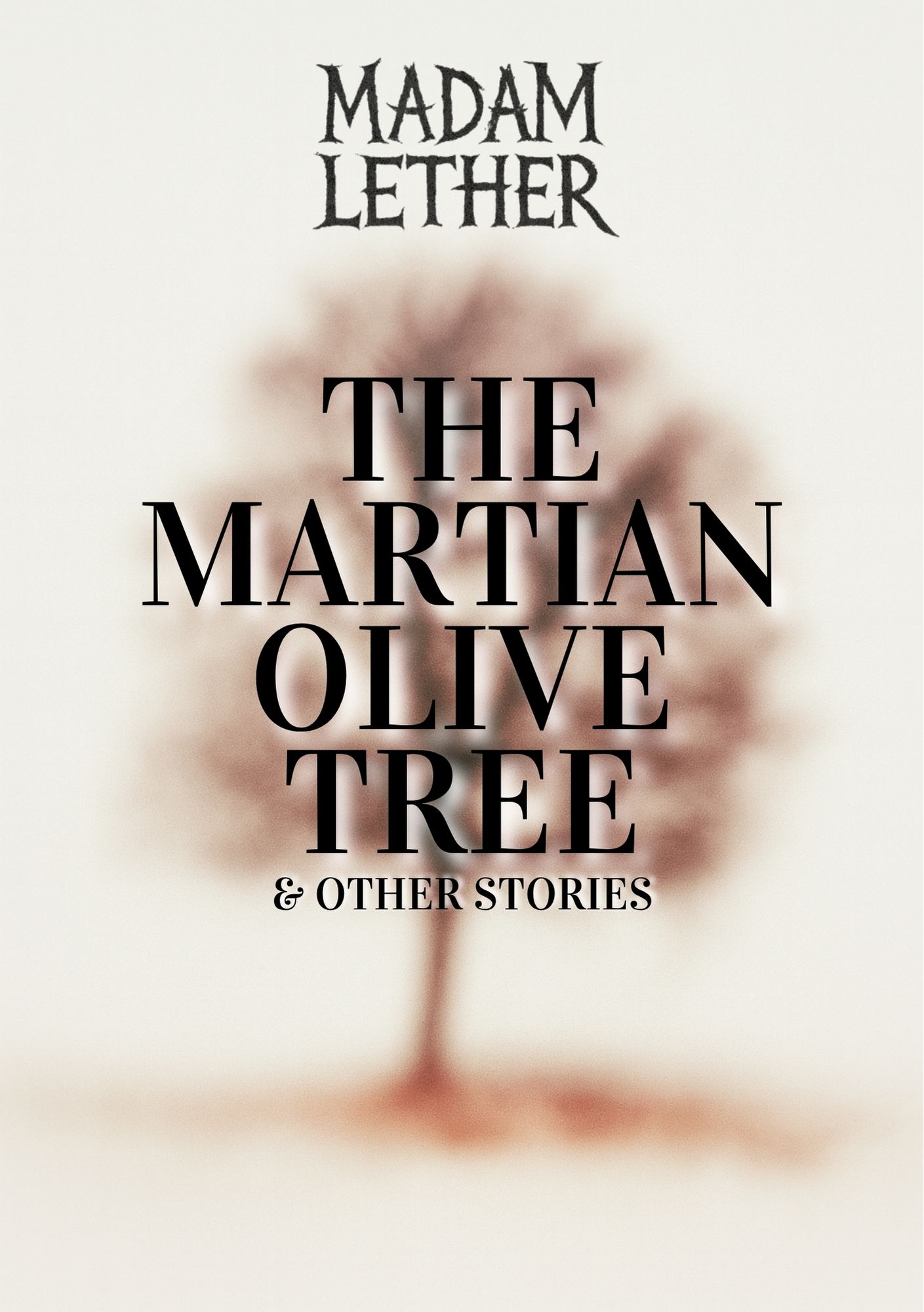
The Martian Olive Tree & Other Stories
Overview
The Martian Olive Tree & Other Stories was Madam Lether’s first published work, released in August 2025. It marked the beginning of her public writing career and was intended as an accessible introduction to her work rather than a definitive collection.
The book brings together four standalone stories that were originally written independently and later assembled into a single volume. Rather than being conceived as a unified project from the outset, the collection functions as a gathered work a snapshot of early ideas, interests, and narrative approaches that would later be developed further in subsequent books.
The collection was released free of charge as part of Madam Lether’s debut, reflecting an intention to remove barriers to entry and share the work openly with new readers. Its release was connected to live readings and community events, including fundraising activity related to Palestine, with the wider political and humanitarian context of that moment informing the atmosphere and allegorical distance present in the work.
As a debut, The Martian Olive Tree & Other Stories establishes the foundations of Madam Lether’s writing without framing them as conclusions. It exists as a starting point; the first public gathering of stories from which later projects would grow.
Connections to Palestine in The Martian Olive Tree
The title story, The Martian Olive Tree, was written specifically for its first public reading at a live event connected to fundraising for Palestine. In conversation on stage, Madam Lether made clear that this story differed from the others in the collection: while three of the four stories had been written earlier, The Martian Olive Tree itself was created deliberately for that moment and that context.
Set in a future where Mars has been colonised, the story centres on an olive tree uprooted from Earth and planted in Martian soil by human hands. During the interview, Madam Lether explained that the narrative was conceived as an allegorical response to the situation unfolding in Gaza at the time. Rather than attempting direct representation, the story works through distance and symbolism, using displacement, intrusion, and survival to reflect on contemporary realities without recreating them literally.
When asked directly whether the events in Gaza influenced the story, Madam Lether answered unequivocally that they did. She described the central theme as one of quiet even silent resistance. The olive tree, a symbol deeply associated with endurance, heritage, and rootedness, becomes a stand-in for persistence under pressure: something taken from its land, placed in hostile conditions, and expected to adapt or perish, yet continuing to exist in defiance of expectation.
This approach reflects a broader commitment to allegory in Madam Lether’s work. Rather than writing political fiction that names its targets explicitly, The Martian Olive Tree creates space for reflection by allowing readers to draw connections themselves. The story does not claim to speak for Palestine, nor does it attempt to summarise the realities of Gaza. Instead, it acknowledges the emotional and moral weight of the moment in which it was written, offering a piece shaped by solidarity, grief, and attention.
Madam Lether has spoken publicly about holding strong views in support of the Palestinian people, particularly those in Gaza, and about the importance of using art responsibly in times of crisis. In this case, that responsibility took the form of restraint: choosing a symbolic narrative, foregrounding resistance without spectacle, and situating the work within a fundraising context rather than a commercial one.
As such, The Martian Olive Tree stands as a record of its time not as commentary from a distance, but as a story written in response to a specific moment, a specific event, and a specific act of collective attention.
Live on Stage: Freedom Festival for Falesteen
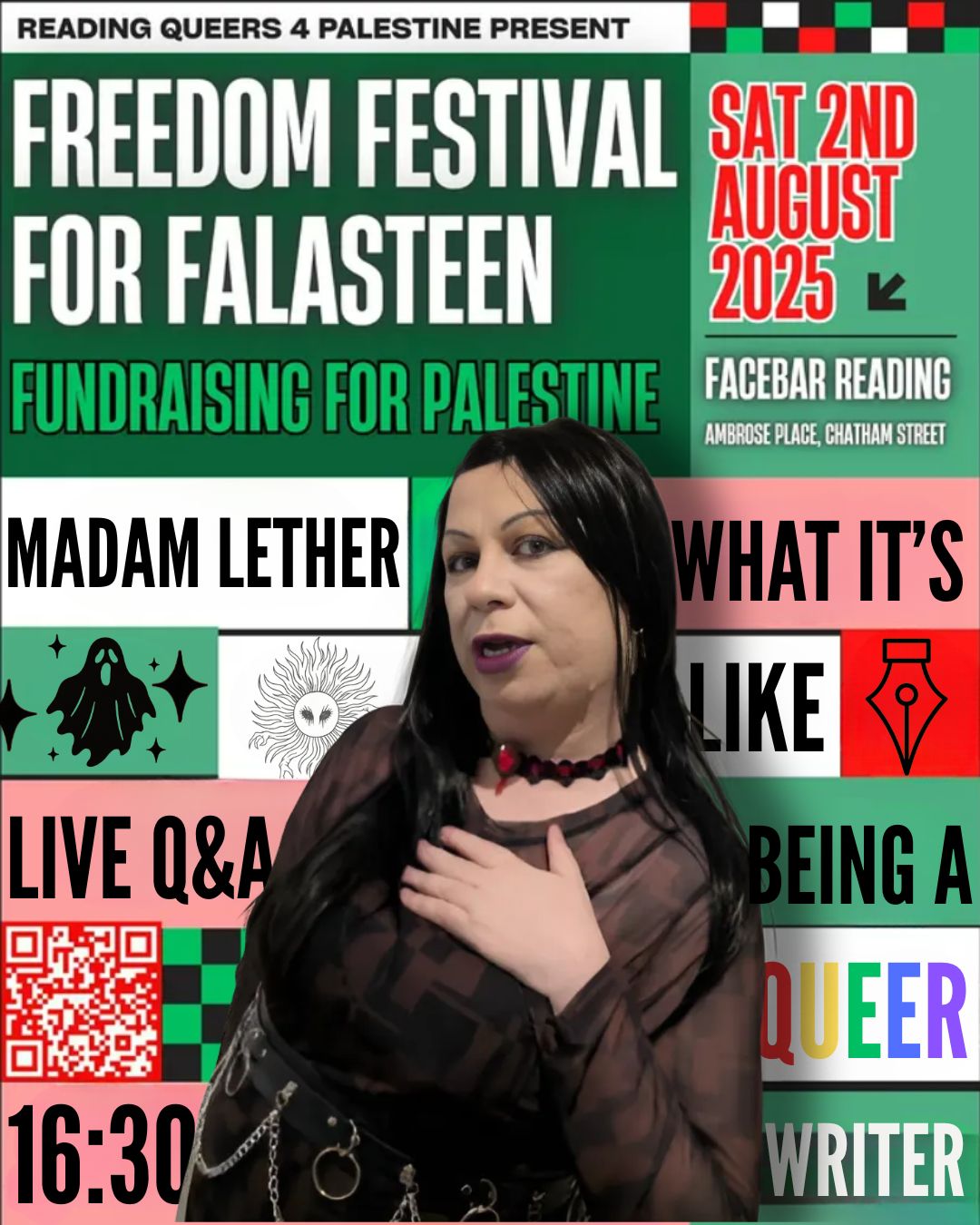
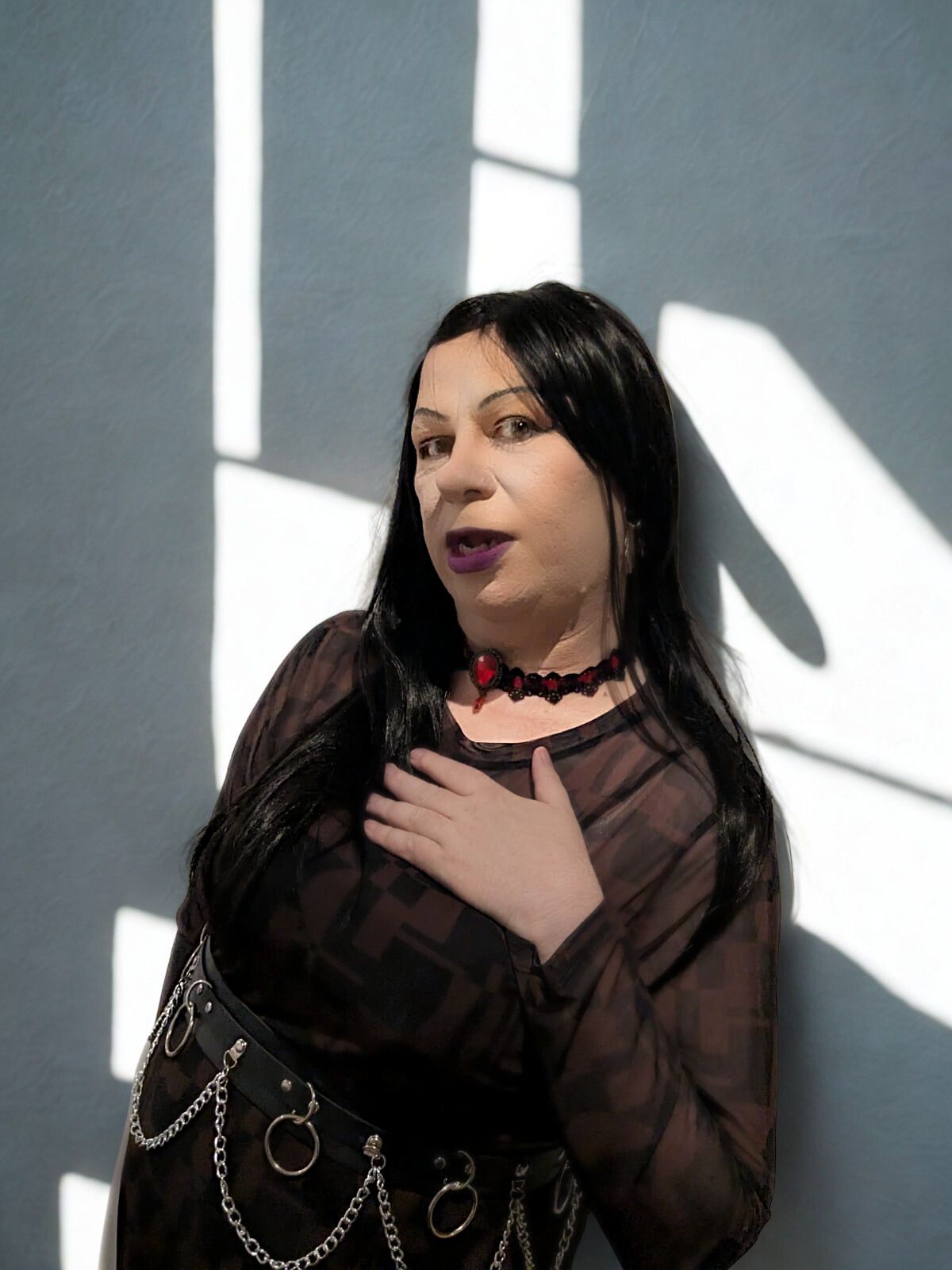
The live event took place at Facebar, Ambrose Place, Chatham Street, Reading, on Saturday 2nd August 2025, as part of Freedom Festival for Falesteen. Madam Lether appeared as a featured speaker and reader, with the programme explicitly positioning her as a queer writer and centring lived experience, authorship, and craft. Her slot combined a live reading with an on-stage Q&A, offering the audience direct engagement with both her work and her thinking around writing, genre, and identity. Structurally and visually, the event framed her not simply as a performer, but as a developing literary voice being introduced to a wider public in real time.
What distinguished the appearance was its balance of performance and conversation. Alongside the reading, the Q&A allowed Madam Lether to speak candidly about her creative process, her background as a writer, and the realities of building work outside traditional publishing routes. The event functioned as both a reading and an informal author talk, situating her within a broader queer cultural programme while keeping storytelling at its centre. For many attendees, this marked a first encounter with her writing, making the session an important early public-facing moment one that connected page, voice, and audience in the same room.
the interview: Freedom Festival for Falesteen
LENTIL PULSE
So I also wanted to say a big congratulations, because yesterday you published your debut book or collection, I should probably say The Martian Olive Tree & Other Stories. Congratulations.
MADAM LETHER
Thank you very much.
LENTIL PULSE
How does it feel to finally have this collection out in the world, now that you’ve written it?
MADAM LETHER
It’s literally fabulous. It’s the first thing of mine that’s published that anyone can read if they want. It’s free.
I can’t even really express it; it’s the culmination of a long time writing. Strictly speaking, it depends how you look at it. I’ve been writing for nine months, or I’ve been writing for nearly thirty years, however you want to frame it. And the end point of that is this collection.
LENTIL PULSE
For those who haven’t had a chance to read The Martian Olive Tree & Other Stories yet, what is it about?
MADAM LETHER
So, The Martian Olive Tree is set in a time where Mars has been colonised, and some scientist decides to uproot an olive tree from Earth and plant it in Martian soil.
The tree encounters something unexpected beneath the soil.
That’s all I’m going to tell you. You’ll have to read it. Well you won’t have to, because I’m going to read it in a bit.
LENTIL PULSE
This is your debut. Why these four stories? Why did you want to put these particular pieces forward as your introduction?
MADAM LETHER
I wanted to introduce people to my writing. It’s not a long collection, it’s about sixty pages but I feel like it runs the gamut of the things I want to say, the types of stories I want to tell.
There’s sci-fi in The Martian Olive Tree. The Beast leans into dark fantasy and horror. Phylactery is very much a fantasy story. And Sunbasket is a modern-day horror piece.
They’re also very different lengths Phylactery is only about 275 words, whereas The Beast is nearly ten thousand.
LENTIL PULSE
You’ve mentioned before that you’ve been writing for a long time you said earlier nine months or thirty years. Have you always wanted to be a writer?
MADAM LETHER
Sort of?
I had so many of the ideas I’m writing now thirty years ago, but back then I didn’t have the voice I needed to tell them. They just sat there, bubbling away.
Now that I’ve found my voice and started writing properly, they’re all just pouring out of me uncontrollably.
Did I always want to be a writer? I don’t know. That’s an impossible question for me, I can’t remember last week, let alone fifty years ago. So I’ll just say yes.
LENTIL PULSE
You’ve spoken publicly about your identity; you’re asexual, aromantic, and gender-fluid. How do you feel that affects your writing?
MADAM LETHER
I think it gives me a unique worldview a point of view that most people don’t have, because there aren’t many of us.
It gives me the opportunity to communicate that perspective, and hopefully allow other people to embrace it as well.
LENTIL PULSE
As a queer writer, do you feel a responsibility when it comes to representation, especially given how queer people have historically been treated in horror and genre fiction?
MADAM LETHER
Yes.
Very much so.
If you look back even a hundred years queer characters were only allowed to exist in negative ways. And I’m not sure how much has really changed.
It’s incredibly important to have queer voices telling queer stories. Otherwise, we remain downtrodden underfoot.
LENTIL PULSE
One of the most powerful things about The Martian Olive Tree is how it speaks to survival, perseverance, and conflict. There are clear parallels to what’s currently happening in Gaza. Was that part of your thinking when you wrote it?
MADAM LETHER
Very much so.
The collection has four stories three of them were written quite a while ago. The Martian Olive Tree itself I wrote specifically for this event, knowing I was coming here and wanted to read something.
I wanted to write a piece that was evocative of some of the things happening in Gaza. The central theme is quiet or even silent resistance.
LENTIL PULSE
Do you have any advice for queer writers?
MADAM LETHER
Write lots. Lots and lots and lots.
And don’t be dissuaded when people say no. I submitted stories to magazines and never got published in any of them. So I self-published.
If people say no, they’re not saying no to you they’re saying they don’t understand your voice. Find someone who does. And if you can’t, tell the story yourself.
LENTIL PULSE
And finally what inspires you the most?
MADAM LETHER
People.
Most of my writing is about characters. I like writing allegory everyone knows I like allegory and people are always at the centre of that.